Showing posts with label From Christianity to Buddhism. Show all posts

Monday, December 9, 2013

Dhammaloka: The Irish Buddhist monk who condemned Christianity

BBC, 6th Dec 2013


An Irishman, Laurence Carroll has a strong claim to be the first Westerner to become a Buddhist monk, and became famous in Burma in the early 20th Century for denouncing the spread of Christianity there.

Carroll was thought to have been born in 1856 in Booterstown, Dublin. He was to later become known as Dhammaloka, meaning 'light of the Dhamma' (Buddhist teaching) or 'word of the 'Dhamma'.

He left Ireland when he was a teenager and travelled to America. After a number of years travelling from place to place, he began working on the San Francisco/Yokohama mail shipping line, but after just three journeys was thrown off the ship in Japan, reportedly due to drunkenness.

From there he made a three-week journey by steamer to Rangoon in Burma where he got work as a tally man at a logging company. It was at this stage he had his first interaction with Buddhist monks.

"The monks had a lot of respect from people and I suspect that Dhammaloka might have been a drinker and they helped him to overcome his dependency on alcohol," explains professor Brian Bocking, head of the School of Asian Studies at the University College Cork.

"It's notable that in addition to atheism, the issue of temperance became a focus of Dhammaloka's preaching as well as his coded anti-colonialism. He became a temperance campaigner for the rest of his life."

The Irishman began to train as a Buddhist monk and was fully ordained before 1900.

His ordination therefore pre-dates that of Charles Henry Allan Bennett (Ananda Metteyya) who has traditionally been dubbed the 'first western Buddhist monk', as Bennett was ordained in the Theravada tradition in 1902.

But how did Carroll reconcile his atheist principles with a spiritual life?

Professor Brian Bocking explains: "He was an atheist but the Dalai Lama is an atheist.

"Buddhists don't believe in God, not in the Christian sense. They don't believe in a creator God that you could interact with.

"What they say is that suffering is caused by the mind - what you have to do is to distil the mind and extinguish any fires of craving and you do that by following a monastic life.

"In that way Buddhism was completely compatible with Dhammaloka's atheism."

Atheism within Buddhism is a principle that still remains intact and Dr Laurence Cox, author of Buddhism and Ireland: from the Celts to counter-culture and beyond, believes that with a rise in secularism people outside of Asia became more open to Buddhist practices. Church attendances in Ireland in the 1970s were measured at 91% but in 2008 that had dropped to just 36%.

"Most Irish people who convert might have had strong associations to Catholicism or Protestantism and were faced with a lot of dogma and they don't want to do the same thing with Buddhism," argues Dr Cox.

"Buddhism allows you to redefine a bit of what matters to you. You're not looking to your own family tradition - you can step outside what can sometimes be stifling conventions and look up and have encounters with a different kind of culture that might have had an effect on you."

Kelsang Chitta is currently the only ordained Buddhist nun in Northern Ireland within the Kadampa tradition.

Having grown up with a Christian background she developed an interest in Buddhism while studying philosophy at Trinity College, Dublin. She believes that people are now attracted to elements of the religion due to its unimposing nature.

"Since the summer, we've had the biggest numbers ever coming to our classes at the [Potala Kadampa Buddhist] centre," she says.

"You can practise the teachings in your daily life, developing compassion without calling yourself a Buddhist.

"Many people would practise in that way. Take the essence of the teachings and practise and that's fine within Buddhism. It's not really necessary to label yourself."

Mixing Buddhist practices with traditional Christian faith in Ireland nowadays is not something that would have gained support with Dhammaloka who had strong views both on Christianity and colonialism.

His outspoken opinion gained him followers but also made him a figure of some notoriety in Rangoon during the first decade of the 20th Century.

And, while his anti-colonial and Christian stance may have made him popular in Buddhist communities in South East Asia it also attracted the wrath of colonial authorities.

Dhammaloka faced minor charges of sedition twice. Once in 1902 and again in 1910.

In 1910 opponents reported him to the chief court of Rangoon after he publicly accused Christians of being immoral, violent and set on the destruction of Burmese tradition.

He was bound over by the judge for a year and his supporters paid the sizeable sum of approximately 1,000 rupees as a surety he would not re-offend.

"Dhammaloka was famous for two things," explains Professor Bocking.

"One, he was a Westerner but a Buddhist monk and secondly, he made speeches that were controversial denouncing Christian missionaries and European colonialism."

Professor Bocking also believes the most significant aspect of Dhammaloka's conversion was that his background was no barrier to Buddhism.

"I suppose the most important thing for us in learning about Dhammaloka is that he opens up a whole world of early Western Buddhists who were not respectable types but who came out of an imperial underclass that was interested in religion."

The manner in which people in the West are encouraged to practise the religion may have changed since Dhammaloka's time but the concept that Buddhism is open to everyone from all kinds of background still resonates today.

Friday, April 22, 2011

Buddhism in UK prisons

by Vasana Chinvarakorn, The Bangkok Post, April 14, 2011


British monk takes Buddha's message of compassion to prison inmates 'gone astray'

Bangkok, Thailand -- It is one singular word of his master that he has been following for over three decades. In 1977 Khemadhammo, a Briton already ordained as a monk, followed Ajahn Chah on what he initially thought would be a two-month trip to revisit his homeland, Britain. One day sitting on a train, the disciple consulted his mentor about how to respond to a request inviting him to serve as a visiting Buddhist minister at three prisons there. "Pai", or "go", was what the late Ajahn Chah uttered.

"That was it. And I have been going to prisons ever since," said Khemadhammo, founder and spiritual director of Angulimala, a chaplaincy organisation that has introduced Buddhism to over a hundred prisons throughout the UK. For his dedicated service to prison inmates, in 2003 Queen Elizabeth II bestowed him with an OBE (Officer of the Most Excellent Order of the British Empire), and the following year His Majesty the King of Thailand granted him the ecclesiastical title of Chao Khun Bhavanaviteht, the second foreign-born monk to receive such an honour.

On his recent visit to Thailand the monk, now 66, was invited to be a keynote speaker at an annual talk organised by SEM (Spirit in Education Movement). It was part of the Thai NGO's month-long programme to improve public understanding of people who have supposedly "gone astray", during which the venerable monk got the opportunity to meet and share his experiences, in a closed-door meeting, with Thai people who work with prison inmates and juvenile delinquents.

Luang Por Khemadhammo began his talk with a brief summary of his background. Born into a middle-class Christian family, at 17 he took up professional acting and later became interested in Buddhism. At 27, he decided to travel to Asia, and ended up in Bangkok where he was ordained as a novice. One day, he chanced upon an old friend from London, who said to him: "If you want to be a real monk, there's only one place: Wat Nong Pah Pong". And off he went to Ubon Ratchathani province where he spent the next five and a half years under the tutelage of Ajahn Chah, one of the most famous meditation masters at that time

Then he returned to England. And from the first three prisons he visited, over time his coverage expanded and the venerable Khemadhammo found himself visiting other prisons, following the inmates as they were transferred to serve their terms elsewhere. During the talk in Bangkok he recalled being teased by some of them as having to serve a "very long sentence."

In the beginning the monk admitted to feeling uncertain in this new role: until then he had neither been to prison nor seen a prisoner. The closest he had ever come was, while still an actor, playing out a character who had been captured.

Then it dawned on him that ''actually, there were some parallels'' between inmates held in captivity and the seclusion of a forest monastery. While inmates are locked away in cells, during his years at Wat Nong Pah Pong the monk was confined to a small hut with no or very few distractions. Without some ability to deal with one's mind, noted the monk, such solitude could become very difficult and painful

Venerable Khemmadatto''There were differences but there were similarities. I too had been uncomfortable and it was my sense of unease that had led me to look beyond the then narrow confines that restricted me for answers. Yes, I realised, I did understand something about imprisonment,'' he conceded.

''And after all, quite apart from any comparisons between prison and monastic life, aren't we all imprisoned by our greed and aversion, by our ignorance, and our prejudices and attachments? It was my belief then, as it is now, that Buddhist techniques equip us with the means to escape that imprisonment and enjoy a secure and lasting peace.''

Thus he set out to teach inmates Buddhism. With more lay practitioners assisting him, on Magha Puja Day in 1985, he founded Angulimala, now recognised as ''the official representative of Buddhism in all matters concerning prison service in England and Wales'', and there is an Angulimala Scotland, too.

Khemadhammo disclosed that there are about 50 Buddhist chaplains in Britain who come from different schools of Buddhism. ''In Angulimala we work together very well'', a phenomenon which is note-worthy in itself, added the monk who also serves as a Buddhist Adviser to the Prison Services Multifaith Chaplaincy Council.

According to the organisation's website, every Buddhist chaplain is required to attend at least one workshop a year, but new recruits must attend two annually the first three years. They get to learn about Buddha's teachings and practices, with particular focus on how they might be applied or taught in prisons, listen to invited speakers involved in Britain's penal system, and share experiences of their past activities dealing with the inmates and their guardians

The venerable monk stressed that the best way to change people is by setting an example. ''When we want people to change, we have to be the institution of that change ourselves. I am very fussy about ensuring that Buddhist chaplains all do their best to practice and train themselves, especially to live by the five precepts of Buddhism - abstaining from killing, stealing, sexual misconduct, lying and consuming addictive substances.''

It may come as a surprise to hear him espouse the value of these precepts that many Buddhists have taken for granted. In particular he ventured how the fifth might be the most important: if you break it, you can break all the rest. A number of inmates he has met committed terrible crimes and had their lives altered tragically just because they used alcohol and drugs.

''I beg you all to take these five precepts seriously. They'll protect you and they'll protect others.''

Why do people commit crime anyway? Is it because of anger, greed, or destitution? He argued the punitive approach - based on the principle that if you hurt someone hard enough, then they won't commit wrong deeds (again) - has been proven it doesn't work. Often, people emerge from prison angry, having no home, money nor family and thus are ready to commit more crimes. Accepting that one cannot stop governments from pursuing their policies, through the Angulimala project, Venerable Khemadhammo and his team have sought to provide an alternative avenue for inmates to do something ''useful and constructive''. They learn how to meditate, to watch their mind and come to terms with themselves. Since the early '90s, thanks to an Angulimala initiative, a handful of prisons in England have allowed the setting up of a ''Buddha Grove'', an area open to prisoners from all denominations to do contemplative work in a quiet, peaceful ambience.

''When it is suggested that I was involved in some kind of Buddhist social action, I'd rather reject that term. I think I am just doing my duty as a Buddhist monk. I feel Buddhism is an amazing teaching and practice. I have had the good fortune to come to Thailand and practice with Luang Por Chah. He once said [to me] 'everything is your practice'.

''What I've been doing with people in the prison is the same as what I do anywhere. When we teach Buddhism, we are trying to offer people a way to end their suffering, a way to deal with kilesa [desire] that brings suffering.

''Of course, people in prison can't come to the temple, so we have to take the temple to them,'' he said.

Like the poignant tale of serial killer-turned-monk Angulimala (see sidebar), the venerable Khemadhammo believes that people can _ and will _ change if given an opportunity. Apparently, he never tires of retelling again and again how Buddha, through his compassion, was able to transform a supposedly evil man without resorting to force. Likewise, in his years of visiting prisoners, he said he has observed some of the so-called ''most notorious and dangerous people'' showing kindness to their fellow inmates, be it to share milk or sugar (which is akin to ''gold'' in such places), or to raise funds to help those family members who need to undergo surgery.

''I think it is very important that we let go of that tendency to make judgements and realise that people are very complex. None of us are just black and white; everyone here has some good things and not very good things. We do unpleasant things. We get angry, jealous, upset, we act on impulses.

''I hope you will learn not to attach to views or opinions, especially the views and opinions about other people. Give everyone a chance,'' he concluded.
----------
For more details about the Angulimala Project and other works by the venerable Khemadhammo, visit his temple's website at http://foresthermitage.org.uk


Monday, December 20, 2010

Becoming a Buddhist in Guernsey

by Richard Moorman, BBC, Dec 20, 2010


Guernsey, UK -- Guernseyman Richard Moorman became a Buddhist in 1997 but said he had been "flirting with the idea" since 1971.

He explained that in that time he had researched the faith and had been practising elements of it before his official conversion.

He said the Guernsey Buddhist Group held meetings open to anyone from any branch of Buddhism or any faith.
Richard said: "We've had Zen and Tibetan Buddhists and people of other religions come to our meetings."

He explained: "They enjoy the chanting, the meditating and the things we do."

Even though meditation is a central part of Buddhist practice Richard said it had its origins in the pre-Buddhist religions of northern India and today was practised by many people both as a religious activity and in secular life.

He said: "Meditation has been shown to lower blood pressure and reduce stress levels - it's a very good thing to do irrespective of the religious association...it sharpens powers of concentration."

Richard decided to make the step of taking on Buddhism in an official capacity following his step-daughter's move to the faith and, along with his wife, began practising a Japanese derivation of the religion.

He explained when they converted to Buddhism they took part in "taking refuge" which involves accepting "the Buddha as your teacher, the Dharma as his teaching and the Sangha as the community of Buddhists".

Richard said Buddhists have "a profound respect for all sincere religious practice".

Using the example of Christmas he said they respected Christians and their celebration of Jesus' birth.
Richard said as he lives in a Christian culture he still celebrated the event: "It's not a religious festival for me but its certainly a time to enjoy being with family."

He said the main teaching of Buddhism is: "We don't exist in isolation to everything else, we are one with everything and everything is one with us... once that becomes a profound insight, it produces great happiness."

Wednesday, November 24, 2010

Disgraced Ex-Congressman Bob Ney Studying Buddhism at Indian Temple

Politics Daily
He's traveled quite a path. Former Rep. Bob Ney (R-Ohio) served six terms in Congress, then spent 17 months in federal prison for his role in the Jack Abramoff scandal. Now he is studying meditation at a Buddhist Temple in India. 

Ney, 56, told the National Journal in a phone interview that since September he has lived in a $10-a-day rented room in Dharamsala, the Dalai Lama's headquarters-in-exile for more than 50 years. The ex-congressman quit drinking, dropped 60 pounds and spends his days meditating with monks and learning the Tibetan language.

Ney, who pleaded guilty to conspiring to defraud the government and making false statements, said he started to try to meditate while in prison to help him cope with the stress of being locked up. Something about it clicked with him, he said, and now he practices meditation daily. 


"You pick a quiet spot, as quiet as you can get," Ney told the National Journal. "You can do it any length of time you want. I usually do it about 10 or 15 minutes. And you focus on your breathing. ... Breath in, breath out. If you hear a sound, you acknowledge it and you just move on back to your breathing."

He said he plans to bring a Tibetan monk back to Ohio with him to train others in meditation. He wants to help the homeless, battered women and veterans suffering from post-traumatic stress syndrome.

"My life is good," he said. "I'm a very lucky person, and I'm just very happy -- very, very happy. I'm doing what I want to do."

Tuesday, November 16, 2010

Ralph Steele

Ralph Steele is the founder of Life Transition Institute in Santa Fe, New Mexico where he serves as the guiding meditation teacher. He has practiced Theravadin Buddhist meditation for over three decades and taught since 1987, including at such venues as Spirit Rock Meditation Center and Insight Meditation Society. He completed a year of intensive practice as a monk in Burma and in Thailand. Along with his interest in preserving the Theravada tradition, he is dedicated to making the dharma available to culturally diverse populations. He has also worked with youth around the country.

Ralph received his M.A. degree from the University of Santa Clara in Marriage, Family, and Child Therapy in 1979. He holds BA degrees in Humanistic Psychology, and Religious Studies with board honors. Ralph is also the Founder of the Elisabeth Kubler-Ross Hospice Training Program at Northern New Mexico Community College. During his tenure as the Chair of the Board of Trustees of Southwestern College in Santa Fe, New Mexico, he was instrumental in transitioning the EKR Hospice Program, from a two year Associate Degree program to a Master’s Degree program in Grief, Bereavement and Counseling. He is a member of the following organizations:

  • Spirit Rock Meditation Center
  • Insight Meditation Society
  • The American Association of Marriage and Family Therapy
  • The American Academy of Pain Management
  • The American Pain Society
Spirituality runs in Ralph Steele's blood. The grandson of a minister, Steele's family has run a church for the past 150 years. A devout Christian upbringing is one of the things that Steele shares with Willis and Jarman—and the vast majority of African-Americans.

He also shares with them the experience of living as an outsider. Steele grew up on Pawleys Island, a then-isolated speck of land off the South Carolina coast populated by freed slaves from Sierra Leone. Steele grew up speaking Gullah, a Creole language formed from Elizabethan English and African dialects. He was 12 years old before he spoke English.

"It has always been a practicing Christian community," he said. "What that means is that when some Christians elsewhere started saying they were 'born again,' that never happened there because no one ever left Christ."

An Army brat, Steele's first exposure to the dharma came during his high school years in Japan, when he began to study martial arts. He remembers the day his instructor leaped up and kicked the rim of a basketball hoop.

"That's when my life began to change," he says. "Right then I knew that life was different from how you see things."

Like so many Vietnam veterans, Steele was nearly destroyed by the war. Along with physical and psychic scars, Steele brought home an addiction to heroin and a five-pack-a-day cigarette habit. He credits devotion to his martial arts teacher and to the discipline of martial arts practice with getting him through.

"It wasn't the martial arts itself," he says. "It was the teacher, the trust in the teacher." Back in the States, Steele enrolled at the University of California at Santa Cruz and signed up for a course on Buddhism—taught by a young black professor named Jan Willis. "I was pretty tough on him," Willis reports without elaboration.

Among the things he learned from her were techniques of meditation from the Tibetan tradition. "That helped, because I was simultaneously going down to Palo Alto VA hospital to deal with flashbacks," he says. "Meditation allowed me to begin to get some balance."


His Christian connection still strong, Steele would go on frequent meditation retreats at a Catholic hermitage in Big Sur, and, for a time, even considered joining the order. But his link with Buddhism was cemented when Willis went on sabbatical and Lama Thubten Yeshe came to teach in her place at UC-Santa Cruz. Not long after, the 16th Karmapa, head of the Kagyu lineage of Tibetan Buddhism, came to town: "I went on a one-week retreat to prepare to meet him. When I went up to get his blessing, we had this exchange: I gave him a rosary and he gave me refuge."

Now a psychotherapist, Steele runs the Life Transition Institute in Santa Fe, a center built around the body-mind meditation practices pioneered by Dr. Jon Kabat-Zinn. But Steele had several stops en route to New Mexico. He practiced briefly in Seattle, using Buddhist psychotherapy techniques, but he began to receive death threats and left for Portland, Oregon, where he spent many months with the renowned Tibetan teacher Kalu Rinpoche. In those days, the idea of teaching Buddhism never crossed Steele's mind. But then, nine years ago at a Metta retreat with Joseph Goldstein, co-founder of the Insight Meditation Society (IMS), Steele looked around and realized that he and one Vietnamese practitioner were the only non-whites in the crowd. Steele recalls that he said, "Joseph, something has to change," to which Goldstein replied, "Yes, but for now just do the practice."

Steele did. But eventually, during a retreat in Santa Fe, he told Jack Kornfield, another IMS co-founder, that he was ready to teach. "I saw myself starting to become a closet practitioner, and I didn't want to do that," he says now. And how does his Christian family back on Pawleys Island take his new role? "They all accept what I do. People walk their practice there. They have a deep understanding of what practice is."


Monday, June 21, 2010

Cher a Buddhist Now

By Robin Leach, June 9, 2010


Las Vegas, USA -- Superstar entertainer Cher has said she is now a Buddhist, but added with characteristic self-deprecation, “who should always be in after-school detention.”
In an interview with Architectural Digest, the record-breaking Caesars Palace headliner shows off her spectacular 4,000 square-foot, two-floor “apartment” perched high above L.A. The magazine describes it as an irrepressible mix of spirituality and spunk.

“My houses,” Cher muses, “are passions.” They also are decorative barometers of the state of her never-boring, ever-expanding consciousness.

“I’ve played around with Buddhism for years,” continues the actress, a devotee of the American Buddhist nun Pema Chodron. “The soul of the universe, everything that I need, I can find in its practice.” Cher turned to friend and interior designer Martyn Lawrence-Bullard to help her conjure “something ethnic, spicy and romantic” in creams, ivories, whites and buttery beiges.

“Though I loved collecting Gothic and can spend hours drawing with every shade of Pantone pen, I prefer a neutral palette, especially in my bedrooms, because the colors are so easy to live with.”

Source: The Buddhist Channel

Saturday, January 30, 2010

Buddhism is an Eastern Way of Life Appealing to Westerners

Ground Report, January 27, 2010
By Jessica Porter

Scarlett Sams works in a Presbyterian Church during the day, but on Thursday nights she attends a meeting of Tibetan Buddhist’s at Ekoji Buddhist Sangha in Richmond, Va. She is a part of a growing Buddhist movement in the United States of every day Americans finding comfort in this Eastern tradition.

“It’s a great community and they are my friends. They are genuine and if I need something, they are there for me. If I’m going through a crisis they are there for me. That is why I am a Buddhist,” Sams said. Although there are no exact statistics, the 2004 World Almanac estimates there are two to three million Buddhists in the United States.  But that number includes not only converted Buddhists such as Sams, but Buddhist immigrants who have brought their religion from Eastern countries.

“Buddhism in American is two camps. One is the Ethnic communities that have centers practicing their own variety of Buddhism. At those places they speak in Vietnamese, or whatever language,” Virginia Commonwealth University Religious Studies Professor Daniel Perdue said. “But by and large it is middle class to wealthy white folks who have adopted Buddhism in all varieties.”

            Buddhism in America is very different from Buddhism in Eastern countries and there the reasons are two-fold. It is a lay person religion, meaning anyone can participate. There is not the same emphasis on monks and monasteries as there is in other parts of the world.

            “[In Tibet] major monasteries had more than 10,000 monks in a country with only six million people. By the time of the fall of Tibet, about one out of three males was a monk. And about 1 out of 4 females was a nun,” Perdue said, emphasizing the monastic importance in the East.

Also, many Americans do not view Buddhism as a religion or as strictly as it is practiced in the East. It is more often viewed as a philosophy or lifestyle.

“Some very famous Buddhist masters made a statement that ‘Buddhism in the East is like an old tree and has no more capability of producing good fruit. Buddhism in the West, even though still young, is very capable of making good fruit,” Huang Tran said. He believes the open-mindedness of Americans and their constant need to question things has allowed Buddhism to take root, unlike people in the East who just accept the religion and don’t question, not allowing any room for change.

Tran grew up in a Buddhist family in Vietnam, but never found comfort in the religion as a child. Due to economic and political hardships he left Vietnam and came to Virginia, where he has lived the past 24 years. Since then, he has become a mixture of Vipassana and Zen Buddhism. He often goes to Saddhama Vipassana Meditation Center, a monastery in Louisa County, and Hue Quang Temple, a Pure Land Temple, in Richmond.

Buddhism can be divided into two types, Mahayana and Theravada. Theravada is more monastic and emphasizes study and meditation while Mahayana is more ritualistic and holds the belief that any person can become enlightened at any time. Mahayana forms of Buddhism are Tibetan, Zen and Pure Land. The Theravada form of Buddhism is Vipassana.

Unlike Buddhism in Asia, where it is most prevalent, there are very few statistics about the amounts of people celebrating types of Buddhism in the United States. There is disagreement in the Buddhist community about which form is most popular in America.

“Tibetan is exploding in the U.S. right now. There’s a combination in Tibetan teaching of the concept of Zen and Vipassana, some practitioners prefer Zen and some prefer Vipassana, but in Tibetan they have both, it’s cool,” Tran said.

But others believe Zen is the most popular. Zen is considered a more intellectual type of Buddhism that goes beyond words and concepts, Kevin Heffernan, leader of the Zen group at Ekoji and Zen Buddhism professor at V.C.U., said.

Ekoji is a row house in Richmond’s Museum District that is home to Zen, Pure Land, Tibetan, Vipassana and a Meditative Inquiry group. Most members are people in the community, like teachers and hospice volunteers, who are not ethnic Buddhists but have found comfort in Buddhism, said Sams. 

Zen also emphasizes the arts like haiku and calligraphy which is appealing to many people. But others have a different idea about why Zen has found such popularity.

“My honest answer is that it has such a nice catchy name. You can market Zen a lot better than you can some of the others because it sounds so cool … nothing quite so sexy in Theravada,” Vipassana Leader at Ekoji Andy Wichorek said.

Wichorek turned to Buddhism after facing hardships in his life. After choosing Vipassana he has been able to see life more clearly. He is now able to make better decisions and holds a higher degree of calm and collectedness. Although Buddhism is not as prevalent as other religions, others like Wichorek are turning to its teachings.

“Buddhism is sort of unique among the seven world religions for its slow spread, it take s a while for the ideas to sink into a culture. Often it is popular among the wealthy before it is popular among the entire population,” Perdue said.

            Although changing slowly, American society is certainly seeing more Buddhist influence. For example, Hollywood has made Buddhism trendy. In many movies Buddhist symbols or references can be seen in the background and many celebrities are openly Buddhist. It is almost as if they are promoting Buddhism, Perdue said.

            Examples of this are Seven Years in Tibet starring Brad Pitt about the fall of Tibet and the Dalai Lama and actors such as Richard Gere and Orlando Bloom who have converted to Buddhism.

Buddhism will only continue on its path to change and grow to become a greater part of American society. According to Tran it is becoming so accepted because it promotes ideas such as harmony, peace, love and kindness that is knitted among all people. But like many aspects of Buddhism, opinions of the future of Buddhism in America are very diverse.

 “[Buddhism] is probably going to continue to get more popular, I don’t know what the ceiling is. Certainly it’s going to remain fairly obscure but there is so much room for growth … but there’s a lot more to go before it really hits the mainstream,” Wichorek said.

            One idea is Buddhism will simply continue to change. People will be drawn to meditation and practice at home and occasionally at a center. A few of them will become more serious and actually go to temple, and then a few of those will go on retreats and seek harder practices. They will become the leaders at places like Ekoji for the people who want to come to a center once in a while, Heffernan said. Cliff Edwards, Religious Studies Professor at V.C.U. has a similar opinion.

            “It’s going to splinter considerably. It doesn’t want to be called Zen, just Buddhism. And if meditation is the special interest just call it meditation. That is what America needs and wants,” Edwards said.

            But everyone agrees that it will gain more popularity. It has grown a lot in the past 30 years and will remain obscure, but will become more popular, Wichorek said. Tran believes that everyone would become Buddhist, if they only had the knowledge.

            “I can see that people offend Buddhism, but Buddhism doesn’t offend anyone, so if one recognizes and they can see, they would know and they would come,” Tran said.

Wednesday, November 4, 2009

Kuala Lumpur's Buddhist Maha Vihara publishes first ever book in LUGANDA language


 Bhikkhu Buddharakkhita was born in Uganda (East Africa). He has learned from various masters in India, Burma, and the US and was ordained by the late Burmese monk Sayadaw U Silananda in 2002. In 2005, he founded the Uganda Buddhist Center in Kampala, Uganda, the first Buddhist Center in Uganda. He has been a resident monk at the Bhavana Society in West Virginia. He is the first African monk to open a temple in the continent of Africa. Previously there have been temples in Africa, but all opened by Asian, European, or American masters or teachers.
For further information, please visit: www.ugandabuddhistcentre.org and http://wisdomquarterly.blogspot.com/


The Buddhist Channel, Oct 23, 2009

Kuala Lumpur, Malaysia -- The Buddhist Maha Vihara in Brickfields, Kuala Lumpur is pleased to launch its first ever Dhamma publication in Luganda, the language of the people of Uganda, in Africa.


This is the 16th language undertaken by the Vihara’s FREE PUBLICATIONS PROGRAM to serve niche Buddhist communities throughout the world.

The book is a translation of “How to Practise Buddhism? authored by Ven Dr K Sri Dhammananda. The book was translated by Nicholas K. Ssewanyana and Tom Kyembe and edited by Bhante U. Buddharakkhita, currently the only native African Theravada Buddhist monk.

Ven Buddharakkhita has also authored another popular book, “Planting the Seeds of Dhamma”- the Emergence of Buddhism in Africa. Bhante’s book was also published by our Vihara in English and Mandarin.

Ven Buddharakkhita was also instrumental in setting up the Uganda Buddhist Center in Kampala, the first ever Buddhist center in Africa set up by a native African Buddhist monk. The Venerable’s mother has ordained to become the first Theravada native African Buddhist nun.

The Uganda centre and its Buddhist population is growing slowly with the support of Buddhists overseas and the small expatriate Chinese, Thai, Burmese and Sri Lankan communities.

The Vihara annually publishes about 200,000 to 300,000 Buddhist books in several languages, and also produces CDs, VCDs and MP3s for free distribution.

The Vihara’s free publications are available in English, Mandarin, Bahasa Malaysia, Tamil, Sinhalese, Vietnamese, Burmese, Thai, Brazilian Portugese, Spanish, Hindi, Kannada, Telegu, Kishwahili and Chichewa. The Vihara also teaches the Dhamma to the Deaf using sign language, the only such Buddhist class in Malaysia.


Tuesday, October 20, 2009

Buddhism Roots Deeply in America


New America Media, Commentary, Andrew Lam, Posted: Oct 18, 2009

While the Dalai Lama was snubbed by President Barack Obama, who refused to meet with him last week, there was an open door policy everywhere else in our nation’s capital – from congressional receptions to synagogues and schools.

One scene in particular is striking: the most famous monk of the 20th Century on the dais, lecturing on wisdom in the modern world as hundreds of enthralled monks and laymen look on below. The scene harks back to the golden era of Tibet, with the halls festooned with hundreds of strings of colorful Tibetan prayer flags, except the event took place at American University.

In the last half of the 20th Century, America cunningly exported itself overseas, marketing its images, ideologies, products and religions with ingenuity and zeal, but what it has not been able to fully assess or prepare for are the effects in reverse. For if Americanization is a large part of globalization, the Easternization of the West, too, is the other side of the phenomenon.

I take it as some cosmic law of exchange that if Disneyland pops up in Hong Kong and Tokyo, Buddhist temples can sprout up in Los Angeles, home of the magic kingdom. Indeed, it comes as no surprise to many Californians that scholars have agreed that the most complex Buddhist city in the world is nowhere in Asia but Los Angeles itself, where there are more than 300 Buddhist temples and centers, representing nearly all of Buddhist practices around the world.

Over the past 25 years, Buddhism has become the third most popular religion in America behind Christianity and Judaism, according to a 2008 report from the Pew Forum on Religion and Public Life. Evidence of Buddhism spreading deep roots in America is abundant.

Last week CNN reported that, “programs and workshops educating inmates about meditation and yoga are sprouting up across the country.” There are more than 75 organizations working with some 2,500 people, most of them prisoners, and they inspired a documentary called “The Dhamma Brothers.”

This December, Thomas Dyer, a former Marine and one-time Southern Baptist pastor, will head to Afghanistan as the first Buddhist chaplain in the history of the U.S. Army.

The Supreme Court is currently deciding on Salazar vs. Buono. At issue is whether a cross that stood in the Mojave National Preserve is a religious symbol or not. The National Park Service had turned down a request to have a Buddhist stupa erected a few years back. The question to ask then: Why should the Christian cross be accepted in a national park as an icon that transcends religion but not a Buddhist symbol? And, what would the high court say about religious plurality if it decides that one religion is to take precedence over another on public lands?

Yet, despite Buddhism’s message of inner peace and compassion, it, in its own way, is a very radical spiritual practice for its refutation of the existence of a creator. In essence, the serious practitioner aims to extinguish the self by defeating his own ego and, thereby, seeing beyond the illusion spun by the ignorant mind.

The ultimate Buddhist experience entails neither god nor self, neither “out there” nor “in here,” for that membrane that separates the practitioner’s being and that of the world, upon awakening, has been lifted. All that remains is - ohm – absolute awe and bliss. Imagine, if you will, Moses not turning his face away from the burning bush that is god but approaching it then fully merging with that terrifying fire.

As ties deepened between the two continents, as immigration from Asia continues, and as the Dhamma [Buddha’s teachings] spreads beyond all borders, we are entering what many thinkers and philosophers call the second axial age, an age of pluralism where the various spiritual traditions co-exist.

In these global days, no single system can exist as a separate entity, nor can its borders remain impervious to change, all exist to a various degree of openness and exchange. And the old Silk Road along which so many religious ideas traveled has been replaced by a far more potent thoroughfare: unprecedented global migration, mass communications, and the information highway, which transcends geography.

I once kept on the wall in my study two very different pictures to remind me of the way East and West have changed. One is an issue from a Time magazine on Buddhism in America. In it, a group of American Buddhists sits serenely in lotus position on a wooden veranda in Malibu overlooking a calm Pacific Ocean. The other is of Vietnamese-American astronaut named Eugene Trinh’s space shuttle flight. The pictures tell me that East and West have not only met, but also commingled and fused. When a Vietnamese man who left his impoverished homeland can come very close to reaching the moon, while Americans are turning inward, trying to reach nirvana with each mindful breath, I think that East-West dialogue has come a long way.

Thursday, October 15, 2009

American-Thai enters monkhood

Pattaya People, Oct 13, 2009


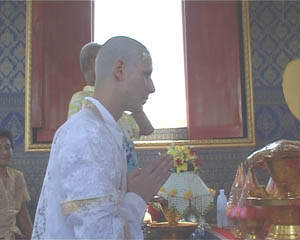
Pattaya, Thailand -- A merit making ceremony was held at Tungklon Talman Temple on the afternoon of the 11th October when Mr. Scott Tanner was ordained into the Buddhist monkhood.

Mr. Maurice Tanner from Texas, where Scott spent most of his early days, and Thai mother Mrs Chammian Tanner, were both in attendance to watch their son being ordained.

Many close friend and relatives turned up to take part in the ceremony held at the temple and later at the Tanner’s residence for a special lunch put on for the occasion.

Friday, September 25, 2009

Being young, here, now

By Nandini Jayakrishna, The Boston Globe, September 8, 2009

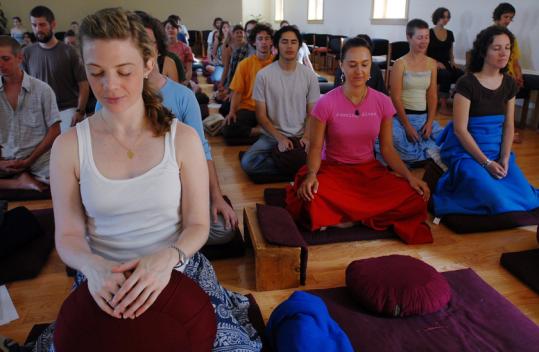
Colleen Cary and others meditated during a retreat last month for those 18 to 32 years old at the Insight Meditation Center in Barre.
Colleen Cary and others meditated during a retreat last month for those 18 to 32 years old at the Insight Meditation Center in Barre. (Christine Peterson for The Boston Globe)

BARRE - Nestled in the woods of this small town, 96 young adults recently gathered at a quiet mansion for a weeklong sojourn, away from buzzing cellphones, humming iPods, and the myriad callings of human and cyber civilizations.

Keeping even the most basic forms of communication, like speaking and writing, to a minimum, they meditated in silence, practicing vipassana, or insight meditation, an ancient Buddhist technique that involves focusing one’s attention on the present, on the breath, mind, and body.

“It was just meditate, eat, sleep,’’ said Kestrel Slocombe, 19, a student at Vermont’s Bennington College who spends much of her time rushing to class, worrying about a novel she’s writing, and painstakingly planning her days, sometimes weeks in advance.

“It was almost like being a child, she said. “You didn’t have to put together a puzzle of a complicated day.’’

At a time when homework or job pressures and the likes of Facebook and Twitter compete for attention throughout the day, meditation groups say an increasing number of young adults are signing up for retreats and classes, seeking a temporary escape, a haven to reconnect with their thoughts.

“Young people are much more stressed out than people 20, 30 years ago,’’ said Rebecca Bradshaw, one of the retreat leaders who also works as a psychotherapist. “We have a fast-paced and alienating culture.’’

Since the Insight Meditation Society, a Buddhist nonprofit, introduced the retreat specifically for 18- to 32-year-olds in 2004, the number of young adults attending to practice vipassana has steadily risen, said Bob Agoglia, the organization’s executive director.

This year’s retreat attracted more applicants than ever from 16 states, he said, and for the first time the group had to turn away more than a dozen applicants.

The Cambridge Insight Meditation Center, a nonresidential nonprofit, has also seen a stream of curious young adults at its weekly vipassana, or “mindfulness,’’ meditation sessions for beginners, said Peggy Barnes Lenart, the center’s operations coordinator.

Harvard’s Humanist Chaplaincy, a community for agnostics, atheists, and the nonreligious, started a free, open-to-all group this year that practices different forms of meditation, including Buddhist and Quaker, said Zachary Alexander, 26, the group’s founder. Half of its nearly 30 members are under 32, he said.

“It’s something that people find can be a break from their stressful lives,’’ said Alexander, who considers himself an atheist.

“It can be something that leads to personal insight.’’

While traditional Quaker meditation emphasizes hearing divine messages, the humanist meditators focus on impulses toward love and truth, and try to accept the events of their lives to gain greater inner calm, said Alexander, a lab administrator at the Harvard Center for Brain Science.

Joshua Beckmann, 28, of Allston, who practices insight meditation, said he enjoys the flexibility Buddhist teachings provide.

“No one’s asking me to profess anything or asking me to call myself Buddhist,’’ said Beckmann, a public health researcher at Boston University who was raised Catholic. “I really appreciate the opportunity to explore.’’

The benefits of meditation, supported by scientific research, might attract younger populations, according to Sara Lazar, a neuroscientist at the Massachusetts General Hospital who conducts meditation research.

Lazar said her team recently studied the brains of about 30 adults - some as young as 18 - before and after they underwent an eight-week insight meditation course.

The results showed that in most participants, the portion of the brain that responds to fear, anger, and stress - the amygdala - became smaller. In animals, the amygdala has been shown to get larger in stressful situations, Lazar said.

About a year ago, the Center for Health Promotion and Wellness at MIT Medical began offering stress-reduction classes that incorporate meditation, said Lauren Mayhew, a program manager at the center.

“A lot of people have a hard time going from their frenetic lives to sitting still,’’ Mayhew said, noting that the classes, discounted for students, tend to fill up on the first day.

“The really crucial age is mid- to late-20s,’’ she said.

“That’s when students wake up and realize that they are mortal beings and that their bodies are affected by stress.’’

Some are drawn to meditation out of sheer curiosity about how their lives might change both during and after meditation.

Angela Borges, 26, a doctoral candidate in counseling psychology at Boston College, turned to insight meditation about two months ago, though she was skeptical of its tangible benefits.

Many have told her she looks much happier, she said.

“I actually have a sense of empowerment,’’ she said.

“I’m running around crazy but there’s just a little part of my attention . . . that sort of says ‘Look what’s happening, notice how I’m living.’ It’s just opened up this new way of being.’’

Sunday, September 20, 2009

Why is Buddhism the fastest growing religion in Australia?

by Darren Nelson

The answer to this inquiry is multi-layered and complex. It is a tantalising issue because it highlights the changing spiritual landscape of Australia and provides an insight into just how multicultural we have really become.

Cultures that were foreign to Anglo-European Australians are now being adopted by some of them - though not without some dissenting resistance. This level of resistance in Australian society can be seen as a litmus test, used to measure future political and religious tolerance in this country.

The story concerning the rise of Buddhism in Australia is a compelling tale of a resilient religion that has survived despite the odds. How is it possible for a 2,500-year-old philosophy, which began five hundred years before Christianity and one thousand years before the Muslim faith, to be relevant to modern life in Australia? Considering all the other ancient religions that have faded from contemporary practice, such as the sun worshippers of Ancient Egypt, the human sacrifices of the South American Mayans and the Druids from the Dark Ages of England, Buddhism has outlasted them all.

It does not preach the dogma of a strange cult, nor seek converts with evangelistic fervour. Those Australians who actively convert to Buddhism do so voluntarily, and are usually well-educated middle-aged professionals who are attracted to a sense of inner peace. This documentary therefore, seeks to immerse itself in the substance of this seemingly magnetic Buddhist approach. Perhaps it will be like seeing Australia for the first time, through ancient eyes.

It is interesting to note that in spite of the recent increase in Buddhist numbers across Australia, Buddhism has actually played a part in Australian history for some time. It did not just suddenly arrive in a recent wave of migrants. Some anthropologists, in fact, have suggested that Buddhism was possibly the earliest non-indigenous religion to reach Australia before white settlement.

Between 1405 and 1433 the Chinese Ming emperor, Cheng-Ho, sent sixty-two large ships to explore southern Asia. Although there is evidence that several ships from that armada landed on the Aru Islands to the north of Arnhem Land, it is not known whether they reached the mainland.

One unproved hypothesis of Professor A.P. Elkin is that the belief of some Northern Territory Koorie tribes in reincarnation, psychic phenomena and mental cultivation is evidence of early contact with Buddhists. Despite certain rock paintings that possibly depict Chinese junks weighing anchor or images of the Buddha, actual material evidence remains to be seen.

The first documented arrival of Buddhists in Australia was in 1848 during the gold rushes, when Chinese coolie labourers were brought into the country to work on the Victorian gold fields. These workers represented a transient population that usually returned home within five years. It was not until 1876 that the first permanent Buddhist community was established by Sinhalese migrants on Thursday Island. There the ethnic Sri Lankans built the first temple in Australia, while they were employed on the sugar cane plantations of Queensland.

From the late 1870’s onwards many Japanese Shinto Buddhists also arrived and were active in the pearling industry across northern Australia, establishing other Buddhist enclaves in Darwin and Broome. Buddhist cemeteries were kept and festivals celebrated. Official government statistics compiled as part of a national census in 1891 indicate that, at the time, there were slightly more Buddhists in Australia (at 1.2%), than there are today (at 1.1%).

Buddhist numbers would have continued to increase if the Immigration Restriction Act of 1901 had not been introduced to combat the ‘yellow peril’. Alfred Deakin, who was destined to be Prime Minister three times, drafted the legislation to pacify a somewhat xenophobic Caucasian electorate. This bill later grew to represent the more broadly implemented White Australia Policy.

For the next fifty years the benefits of mind training and meditation, as taught by Buddhism, would be disregarded as some sort of obscure ‘eastern mysticism’. Except for some remote surviving pockets of Buddhists (such as Broome and Thursday Island), the religion became virtually extinct in Australia.

A small group of committed western Buddhists formed the earliest known Buddhist organisation in Australia, The Little Circle of the Dharma, in Melbourne in 1925. Progress was slow though, until after World War II when local enthusiasm for the White Australia Policy began to decline. In 1951 the first Buddhist nun visited Australia. Sister Dhammadinna, born in the USA, ordained and with thirty years experience in Sri Lanka, came to propagate the Theravadin School of Buddhist teaching. She received nation-wide media coverage.

Inspired by this visit, the next year the Buddhist Society of New South Wales was formed under the presidency of Leo Berkley, a Dutch-born Sydney businessman. This organisation is today the oldest Buddhist group in Australia. Its membership was, and still is, compromised mainly of people from Anglo-European backgrounds.

In 1958 the Buddhist Federation of Australia was formed in order to co-ordinate the growing Buddhist groups that had sprung up around the country in Western Australia, South Australia, Queensland and Victoria.

The Buddhist presence in Australia had depended for the first hundred years on lay people with only the occasional visits by ordained members of the Sangha (the Buddhist clergy). But in the 1970’s the growing number of Buddhists created a need for resident monks, and a new phase in Australian Buddhism began.

In 1971 the Buddhist Society of New South Wales established the Sri Lankan monk, Somaloka, in residence at a retreat centre in the Blue Mountains west of Sydney. This became the first monastery in Australia. A succession of monasteries representing different aspects of Buddhism slowly became established around Australia; in 1975 at Stanmore in Sydney, in 1978 at Wisemans Ferry in country NSW and in 1984 at Serpentine in Western Australia.

The charismatic face of Buddhism, the Dalai Lama, (who was awarded the Noble Peace Prize in 1989 and describes himself as ‘a simple monk’), has travelled the world constantly giving lectures and answering questions in 20,000 seat pop concert halls. John Cleese speaks out for him in London, Henri Cartier-Bresson records his teachings around France and Adam Yauch of the Beastie Boys pop group has even interviewed him in Rome for Rolling Stone magazine.

In the past few years he has opened eleven Offices of Tibet, everywhere from Canberra to Moscow and last year alone provided prefaces and forewords for roughly thirty books. The 14th Dalai Lama, who holds the titles of Ocean of Wisdom, Holder Of The White Lotus and Protector Of The Land Of Snows, has even served as the guest editor of French Vogue magazine.

The three visits of the Dalai Lama to Australia in 1982, 1992 and 1996 were joyful occasions for Buddhists of all traditions, and huge crowds of Buddhists and the general public gathered to hear him speak. On the third visit, and despite virulent Chinese protests, the Dalai Lama met with and was photographed with the Prime Minister of Australia, John Howard. It was now clearly evident at this stage, that Buddhism had become a significant minority religion in Australia.

During this visit local celebrities contributed generously to fundraising activities. For example, Kate Ceberano, Rachel Berger and Frente were just some of the ‘star-studded cast’ to perform at the Dalai Lama Lounge Room. They helped to raise $14,000 over three nights. Mushroom Records released a benefit album called The Mantra Mix CD, featuring Jenny Morris, Jimmy Barnes and Johnny Diesel. One local advertising agency, providing their services for nothing, came up with the slogan "You missed Jesus. You missed the Buddha. Do not miss the Dalai Lama". When was the last time such hype accompanied the visit of a religious leader?

But Australians are not alone in their sympathy towards his cause. The issue of Tibetan oppression has come to the attention of Hollywood and with two new films about his life in the cinematic pipeline, the Dalai Lamas’ profile has not only moved into the mainstream, but has (much to the horror of the Chinese Government) gone global.

The first to be released, Seven Years In Tibet, tells the story of Heinrich Harrer, a mountain climber and Nazi party member who encounters his own sense of enlightenment after becoming the tutor to the young Dalai Lama in Tibet in the 1940’s. The film has attracted healthy attention because it stars Brad Pitt.

The other film is Kundun, directed by Martin Scorcese. This epic tells the remarkable tale of the Dalai Lama from his point of view, from his recognition as the reincarnated Buddha of compassion at age two until his escape to India at twenty-four. Recently released here in Australia, it was reviewed by Channel Nines’ Sunday program on June 14th and described as ‘the most beautiful and important film released this year’.

Hollywood’s fascination for Buddhism extends beyond these two screenplays, with many stars expressing interest in the religion itself. In February 1997, the karate-kicking action star Steven Seagall was recognised by the Nyingma lineage of Tibetan Buddhism as the reincarnation of a 15th century lama. Adam Yauch of the Beastie Boys pop group has organised two huge benefit concerts to publicise the plight of Tibet.

Actor Richard Gere, together with Uma Thurmans father, Richard Thurman, has opened Tibet House in New York, published books on the subject, and meditates daily. Other practitioners that have come to attention include Tina Turner, Harrison Ford (whose wife Melissa Mathison wrote Kunduns script), Oliver Stone, Herbie Hancock, Courtney Love, composer Philip Glass (who also worked on Kundun) and REM’s lead singer Michael Stipe.

The momentum of Buddhism’s’ profile is driven by other, more subtle reminders as well. A new make up is being advertised as Zen Blush, a new sitcom is called Dharma and Greg, a designer fruit juice container has on its’ label "Please recycle this bottle. It deserves to be reincarnated too", and monks star in television commercials and news items.

Such recent exposure does not take away the fact that Australians have been quietly turning to Buddhism for some time. The statistics compiled in the 1986, 1991 and 1996 Commonwealth Government Census support the view that Buddhist numbers have been steadily increasing. Between 1986 and 1991 the numbers of practitioners rose from 80,387 to 139,847, a growth of 74%. Due largely to the decrease in immigration numbers in recent years the percentage growth for Buddhists slowed between 1991 and 1996 to 43%, from 139,847 to 199,812. This rate of increase is still higher than that of any other religion.

The three census surveys also indicate that of the eight Christian denominations listed in the analysis for New South Wales only three show an increase (Baptist, Catholic and Orthodox), while five (Anglican, Church Of Christ, Lutheran, Presbyterian and Uniting Church) have decreased in numbers.

Does the fluctuating demographic between Buddhism and Christianity point towards dissatisfaction with traditional Australian religious beliefs? Is Buddhism more competitive than Christianity or is one spiritual experience simply more meaningful than the other?

Of the 199,812 Buddhists across Australia today, approximately thirty thousand are Anglo-European’s who have ‘crossed over’, by choice, to this alternative philosophy. They have turned from ‘Christian sinner’ to ‘Eastern Mystic’. The slump in immigration figures from Buddhist countries is apparently not enough to stall the continued growth in Australian Buddhism, especially now that local support has been established. Back in 1938 a Japanese Shinto monk, noting that it took China three centuries to adopt Buddhism from India, said introducing it in the West would be like holding a lotus to a rock and waiting for it to take root.

When the Age of Aquarius spread across the world in the form of the 60’s alternative hippie counter-culture, there appeared to be no shortage of poets, artists, actors, writers and musicians interested in a voyage of inner peace through Buddhist philosophy and meditative practices. John Lennon used Buddhist mantras’ in the lyrics of his music such as Across the Universe. Allen Ginsberg used a mantra (Buddhist blessing) to bless the ground at Woodstock before the first fans arrived. Zen meditation too, first embraced by the Beat poets in the 1950’s flourished across first world nations as a healthy alternative to LSD-induced enlightenment.

More importantly the drug-fuelled 1960’s, when the Vietnam War was at its height, feminist protestors burnt their bras and man landed on the moon, saw a relaxation of traditional middle class values that allowed a greater versatility in public consciousness. During this time, people had greater access and freedom to experiment with new schools of thought (feminism, civil rights, the peace movement, alternative lifestyles etc) without suffering as many social ramifications as in the past.

According to the Reverend Phillip Hughes, a Melbourne-based religious researcher, "many people thought in the 1960’s that science itself was not sufficient to really explain existence, but then they were not keen to go back to the Judeo-Christian tradition with its holy books, miracles and so forth. Also the need for a sense of peace has become more apparent".

Potential Buddhists are attracted to the Dharma (Buddhist teachings) not only to take refuge from a world of chaos and confusion, but also to re-invent their own personal sense of a meaningful spirituality in a society of high-tech consumerism, commercialism, violence and apathy. Compared to the Christian beliefs many Anglo-European Australians grew up with, Buddhism does not require its adherents to remain faithful to a specific dogma.

It is not a faith. It is not technically a religion either, though when discussing systems of worship it is easier to work with that label. It is more a psychology and a philosophy wrapped around a moral code of mind training.

The founder of Buddhism, Siddhartha Gautama (born in 563 B.C.), turned his back on the royal family he had been born into, to live life as a simple ascetic monk. At the age of thirty-five he became enlightened and ‘saw things as they really are’, having achieved a mental state of absolute egolessness, where he no longer felt any sense of narcissism or craving.

He became the first Buddha and was quick to teach his disciples that he was not a god, should not be revered and no rituals should be developed around his teachings. Heaven and hell, he taught, are not external places that we travel to after we die; they do not in fact exist. Rather, both places dwell only in the hearts of people. People are either good or bad, pious or evil. Paradise exists within our spirit, it is here and now, and not some destination in the after-life.

Meditation, he believed, is the process required for all adherents to achieve Buddhahood. This is one of the main differences between Buddhism and other religions. Practitioners are offered an ultimate goal, enlightenment itself, which is equivalent to the level attained by the Buddha himself. He taught that everyone is capable of achieving this, providing equality to all his followers.

This is a radical departure for born-Christians to realise when they first start studying the principles of Buddhism. The best a faithful Christian could hope to achieve with his devotion was entry to heaven as an angel where he is still subject to the will of a greater being who could smite him anytime at will. The Buddha teaches his disciples too become the same as he, which is why he is not a god. In Buddhism there is no pecking order in the after life, because that would require the presence of an ego, which is the Buddhists life work to gradually eliminate.

Buddhism dispenses with the notion of a Supreme Being, as does science, and explains the origins and workings of the universe in terms of natural law. All of this certainly exhibits a scientific spirit. The Buddha advised that we should not blindly believe him but rather question, examine, inquire and rely on our own experience. This scientific approach of cause and effect was not overlooked by Albert Einstein in the 1930’s:

"The religion of the future will be a cosmic religion", he said, "it should transcend a personal God and avoid dogmas and theology. Covering both natural and spiritual, it should be based on a religious sense arising from the experience of all things, natural and spiritual, and a meaningful unity. Buddhism answers this description. If there is any religion that would cope with modern scientific needs it would be Buddhism".

While the antipodean blossoming of Buddhism seems to have gone from strength to strength since the 1980’s, this has not always been the case. It is in the Buddhist principle of godlessness that the journalist can find opposing and dissenting voices to the Buddhist cause. This theological bone of contention is the main source of friction with other religions.

On Wednesday, the 18th of January 1995, Pope John Paul II arrived in Sydney and attended an Interfaith Gathering in the Sydney Domain. Representatives from major religions, including Protestant, Orthodox and Coptic Christians, Jewish and Muslim were invited to share the platform with him. Notable by its absence was Australia’s’ third largest religion, Buddhism.

The organisers told SBS Radio that they were unaware that Buddhism was Australia’s’ third largest religion and besides that there was no national leader of Buddhism, so who were they to invite? The Sydney Morning Herald reported that "somebody in the State Government had forgotten to invite the Buddhists". This is unlikely, as the New South Wales Government is very aware of the presence of Buddhists in this state and often invites Buddhist representatives to State functions. A more likely explanation is that the Vicar of Rome holds Buddhism in very low esteem as is evident from the following extract from his book, Crossing The Threshold Of Hope:

"Buddhism is in large measure an ‘atheistic’ system. We do not free ourselves from evil through the good which comes from God; we liberate ourselves only through detachment from the world, which is bad. The fullness of such a detachment is not union with God, but what is called nirvana, a state of perfect indifference with regard to the world. To save oneself means, above all, to free oneself from evil by becoming indifferent to the world, which is the source of evil. This is the culmination of the spiritual process. Christian mysticism is born of the Revelation of the living God. This God opens Himself to union with man, arousing in him the capacity to be united with Him, especially by means of the theological virtues - faith, hope and above all, love".

Graeme Lyall, Chairman of the Buddhist Council of New South Wales, strongly refutes the Catholic position. "The Oxford Dictionary defines ‘atheism’ as ‘disbelief in the existence of God’ ", he said, "the Buddha is described as the teacher of ‘gods and men’, so how can Buddhism be an atheistic system? Religious arguments often come down to the use of religious language. We must ascertain to what we are referring to when we use the term ‘God’.

What is a ‘living God’? Anything that is living is subject to death and decay, so why should we place ourselves in the hands of something, which, like ourselves, is impermanent? If he is referring to the old man with a white beard who sits in the sky taking notes in his little black book ready for the day of judgement, then he is out of step with modern theological thinking and most other theologians.

Modern theologians, such as Paul Tillich, suggest that the term ‘God’ refers to the ‘ground of being’ - the very fact of existence. No Buddhist would argue with this, but they may be reluctant to use the term ‘God’ to describe it".

Lay’s implication that the Pope is out of touch appears to be more than just a knee-jerk defence, when you consider that the ranks of Catholics themselves are split on the issue. Irish-born Father William Johnston, a Jesuit priest, spoke of his sympathy to Buddhism when he visited Sydney in early January 1997. Here to attend the Religion, Literature and Arts Conference at the Australian Catholic University, Father Johnston spoke of the Christian churches need to introduce aspects of Eastern Mysticism - such as meditation, yoga and Zen - if they want to increase numbers attending weekly services.

"Some Catholics are very nervous about meditation but there is a lot to learn from it and yoga and Zen", he said. "The Catholic Church has always kept meditation very strongly in its religious orders; our problem is that we didn’t teach it to the laity, who are now looking for it".

Father Johnston, director of the Institute of Oriental Religions at Tokyos’ Sophia University, has lived in Japan since 1951 and believes Christianity has become ‘too legalistic’, with ‘too many do’s and don’ts and not enough vision and enlightenment’.

Besides the Catholic Churches’ potentially bilateral reaction to Buddhism, local opposition to the arrival of Eastern Mysticism has also occurred in the steel manufacturing town of Wollongong, an hours drive south of Sydney. There the Anglican Bishop of Wollongong, the Reverend Reg Piper has weighed into the debate expressing his annoyance not only at the presence of Buddhism, but the presence of a philosophy he sees as evil.

The contest began when a Taiwan-based Buddhist sect, Fokuangshan, opened a huge fifty million-dollar temple just south of the steel city in Berkley. The monks there planned to promote their style of ‘humanistic’ Buddhism, which emphasises the ‘oneness and co-existence of the global village’.

The Fokuangshan sect was founded in the mid-1960’s and has more than one hundred branches world-wide (including Brisbane, Melbourne and Perth) with 1.5 million members and its own university, several schools, an organ donor bank, a retirement home, even a cemetery. This growth is due to its’ charismatic founding father, the Venerable Hsing Yun. The size of the Wollongong temple, called Nan Tien, is second only to their headquarters in Taipei.

Bishop Piper’s concerns are not shared by other Christian churches such as the local Uniting Church, which has adopted a user-friendly approach to the temple. On Tuesday, the 18th of June 1996, Bishop Piper appeared on the ABCs’ 7.30 Report to voice his opposition.

Bishop Piper: See when you have the bible view of humankind, generally, if it is outside the framework of the truth - the bible terms it as evil.

Reporter: Is it a deception?.

Bishop Piper: In that respect, yes. While ever it is not based in the truth of Christ, it would be a deception. Because Buddhism is basically an atheistic religion. There is no god.

Reporter: Why is that a problem?.

Bishop Piper: Because God has revealed himself through Christ. Christ has been raised from the dead. He said he is God. There is no other way to the truth and no other way to really live except through Christ.

The growing curiosity about Buddhism has so worried Bishop Piper that he has made a video called In Search Of Paradise - A Biblical Response To Buddhism. It is to warn all Christians of the evil deception of Buddhism, that has arrived to convert them.


Reverend Shin of the Nan Tien temple (pic) remains perplexed with Bishop Pipers attitude. "We don’t convert people to Buddhism or change their religion", he said. " As long as they feel comfortable with any of the practices or any of the beliefs and it is good for the society, good for them and good for the family, that is the most important thing. Whether they decide to become Buddhists or not - that is not our concern".

Local opposition to Buddhism also extends beyond the Christian clergy. A survey by the Federal Office Of Multicultural Affairs, conducted in 1988, found that 41% of the general population did not wish to have a Buddhist as a workmate. Only Muslims fared worse.

Despite this, on Sunday 8th February this year Australian Buddhists were delighted to learn they had a friend in a high place when the Governor-General, Sir William Deane, expressed his support at the opening of the Rahula Community Lodge in Canberra.

"A report from the Bureau of Immigration, Multicultural and Population Research a couple of years ago, showed that over the ten years to 1991 Buddhism was by far the largest growing religion in our country: an increase in the order of some 300%" he said. "To a significant extent, of course, the figures reflect the substantial increase in migration from south-east Asia over that period.

But the second largest national group were Australian-born Buddhists - many from non-Asian cultures attracted by both the philosophy and the practice of Buddhism, with its emphasis upon the search for inner peace and understanding. I offer my very best wishes for the success of all that you hope to achieve in the years ahead as future stages of the centre are completed. May all your endeavours prosper and bring joy to those whom they are intended to help".

Buddhism continues to maintain a steady trickle of recruitment at the grass roots level. According to the Venerable Pannyavaro, a monk based in Surry Hills in Sydney, young people are still attracted to Buddhism because they are looking for an alternative to established Christian churches and they can explore Buddhism without feeling obliged to join.

"A lot of young people in the twenty to mid-thirty age group are coming because they don’t feel imposed upon", he said, " and there are deeper meditative techniques they can draw upon". The Buddhist website he operates (http://www.buddhanet.net) gets an average 50, 000 ‘hits’ a day. Venerable Pannyavaro offers cyber-nirvana at this site in the form of online meditation sessions where people can log on, meditate and contemplate the infinite.

There are now more than ninety Buddhist temples and organisations in New South Wales, sixty-five of them in Sydney. The bulk of the two hundred people who each week visit the Buddhist Library, Meditation and Information Centre in Camperdown in Sydney are in the thirty to fifty age group. About eighty-percent are from a non-Asian background.

Much to the horror of the Christian clergy (if they ever find out), Buddhism is even being taught in one New South Wales primary school during religious scripture classes. In early 1995 at Blackheath Primary School a group of parents approached the principal, Kate Allan, asking the school to provide Buddhist instruction as well as the traditional Catholic and Protestant options. Now, forty-five of the schools three hundred and fifty students attend classes in Buddhism.

"The move came from the community", Allan says. "In the mountains we have quite a diverse community and it was the choice of the parents to have these classes - it was not something imposed on the whole school".

Answering the question of Buddhism's growing popularity in is clearly going to be a rich and involved conclusion. This religion seems to have, at first glance, a vigorous influence on the world stage. Just when you think you have examined the issues thoroughly, you suddenly discover that you are still only looking at the tip of the iceberg.

source: http://www.buddhanet.net/whybudoz.htm