Showing posts with label From Catholicism to Buddhism. Show all posts

Sunday, October 11, 2009

A Look at Christianity, Through a Buddhist Lens

By PETER STEINFELS, The New York Times, October 9, 2009


Five decades ago, Paul F. Knitter, then a novice studying to become a Roman Catholic priest, would be in the seminary chapel at 5:30 every morning, trying to stay awake and spend time in meditation before Mass.

Last Wednesday, at the same hour, he was sitting on his Zen cushion meditating in the Claremont Avenue apartment he occupies as the Paul Tillich Professor of Theology, World Religions and Culture at Union Theological Seminary in New York.

A few hours later he was talking about his pointedly titled new book, “Without Buddha I Could Not Be a Christian” (Oneworld). The book is the outcome of decades of encounters with Buddhism — and of struggles with his own faith.

Born in 1939, Mr. Knitter began his path to the Catholic priesthood at age 13, studied theology in Rome during the years of the Second Vatican Council, was ordained in 1966, completed a doctorate in Germany and began a long and influential career as a scholar addressing questions of the relationship between Christianity and other world religions.

He received permission to leave the priesthood in 1975, taught for many years at Xavier University in Cincinnati and after his retirement was invited to Union Theological.

“Am I still a Christian?” he asks in his new book. It is a question posed over the years by others, including some unhappy officials in the Vatican. But the question, he writes, is also “one I have felt in my own mind and heart.”

“Has my dialogue with Buddhism made me a Buddhist Christian?” he writes. “Or a Christian Buddhist? Am I a Christian who has understood his own identity more deeply with the help of Buddhism? Or have I become a Buddhist who still retains a stock of Christian leftovers.”

The struggles Mr. Knitter is writing about are not the familiar ones about sexual ethics, the role of women or the failures of church leaders.

His focus here is on what he calls “the big stuff”: What does it really mean for Christians to profess belief in an almighty “God the Father” personally active in the world, or in Jesus, “his only-begotten Son” who saved humanity through his death and bodily resurrection, or in eternal life, heaven and hell?

However much he tried, Mr. Knitter found that certain longstanding Christian formulations of faith “just didn’t make sense”: God as a person separate from creation and intervening in it as an external agent; individualized life after death for all and eternal punishment for some; Jesus as God’s “only Son” and the only savior of humankind; prayers that ask God to favor some people over others.

Mr. Knitter’s response, based on his long interaction with Buddhist teachers, was to “pass over” to Buddhism’s approach to each of these problems and then “pass back” to Christian tradition to see if he could retrieve or re-imagine aspects of it with this “Buddhist flashlight.”

He was not asserting, as some people have, that religions like Christianity and Buddhism are merely superficially different expressions of one underlying faith.

On the contrary, he insists they differ profoundly. Yet “Buddhism has helped me take another and deeper look at what I believe as a Christian,” he writes. “Many of the words that I had repeated or read throughout my life started to glow with new meaning.”

Those new meanings will unsettle many Christians, as Mr. Knitter recognizes, even as they address difficulties felt by many others. This will vary, of course, from issue to issue. Mr. Knitter’s translation of Buddhist meditation into a call for a Christian “sacrament of silence” may be readily welcomed. His search for a “non-dualistic” understanding of God and the world may be only leading him through Buddhism back to Thomas Aquinas.

“Perhaps I could have come onto these insights without Buddhism,” he said Wednesday. Yet even in those cases he often expresses these insights in language that will be debated, like God as “InterBeing” or “Connecting Spirit.”

When his comparison between “Jesus the Christ and Gautama the Buddha” leads him to conclude that both are “unique” saviors but not sole or final ones, he is treading, as he well knows, in a theological minefield.

One can predict that this book will receive instant condemnation from people who feel their duty is to protect Christian doctrine from wandering off course.

One can also predict that those condemnations will, in turn, make others hesitant to voice more nuanced, thoughtful criticism out of fear of piling on.

Mr. Knitter and his book deserve better. It is easy to draw up a list of substantial criticisms. For one thing, Mr. Knitter’s Christianity comes laden with all the impurities of popular piety and workaday theology while his Buddhism seems to be that of the best and the brightest.

Some readers may detect the reflex of the lifelong recovering cleric in his recoiling from whatever might appear to be patriarchal or excluding. And most important are questions about the nature and use of religious language for pointing to a mystery that can never be captured in human words.

Yet serious critics, no matter how major their differences, will not be able to ignore the enormous, almost disarming honesty of this book. Mr. Knitter admits his painful puzzlements and conducts his search for answers out in the open. He does not hide behind academic abstraction but writes clearly and personally and leaves himself open to correction.

Although he argues for a kind of religious “double-belonging,” he does not hesitate to ask whether this is ultimately a kind of promiscuity — or, as one of his students put it, “spiritual sleeping around.”

Mr. Knitter doesn’t believe so. But he has written his book in part to see whether fellow Christians agree.

Will his “double-belonging” resonate sufficiently within his own faith community that he can continue to consider himself a Buddhist Christian? Or if not, as he explained this week, will he feel obliged to recognize himself as a Christian Buddhist?

One need not have a stake in that outcome to find “Without Buddha I Could Not Be a Christian” a compelling example of religious inquiry.

Friday, July 10, 2009

Venerable Robina Courtin


Venerable Robina Courtin has been a Tibetan Buddhist nun for over thirty years. She is an internationally renowned Dharma teacher who is famous for her no nonsense approach. At the end of 2000 she resigned as editor of MANDALA, international magazine of Buddhism, to increase teaching at Buddhist centers around the world. Since 1997, she has run the Liberation Prison Project for Buddhist Practitioners, which works with people in prisons throughout the US, helping them with their practice and studies by writing them and sending books and tapes and other materials. She visits prisons in California, Massachusetts, Kentucky, North Carolina and Virginia, giving teachings to groups and meeting them one-to-one. Several of these men are on death row or have life sentences, and some have been involved in gangs, both on the streets and in prison.

Venerable Robina was born in Melbourne, Australia and brought up as a Catholic. She studied classical singing until her early twenties, then went to London in 1967, where she lived for four years. She became actively involved in the radical left, working mainly with a London-based support group for black and Chicano prisoners. In the early seventies she became a feminist and returned to Melbourne in 1972 to work with other radical feminists. Robina began studying martial arts in 1974 in her quest for a spiritual path, moving to New York where she studied karate. She continued karate in Melbourne until 1976, when she attended a Tibetan Buddhist course in Queensland given by Lama Yeshe and Lama Zopa Rinpoche. She went to Kathmandu, Nepal, and eighteen months later in November 1977, she left everyting behind and ordained as a Buddhist nun at Kopan Monastery. Nowadays, Venerable Robina Courtin is one of the most popular teachers of Buddhism in the west. Venerable Robina's prison work was recently profiled in an award-winning documentary, Chasing Buddha.
The Mitra Youth Buddhist Network

Sunday, July 5, 2009

Venerable Sujato

Venerable Sujato (Anthony Best) was born in Perth, Western Australia. Impressed by the profound visions of the world opened up through science, and especially the Theories of Relativity, he rejected his Catholic beliefs while in his teens. After playing rock n’ roll guitar professionally in a successful popular band called Martha’s Vineyard for several years, he went to Thailand in 1992. There, despite having no previous experience of Buddhism, he fell into an intensive retreat at a monastery in Chieng Mai, where he ordained as a Bhikkhu the following year. Besides spending 3 years in Bodhinyana monastery with Ajahn Brahm, he also spent several years in remote hermitages and caves in Thailand and Malaysia. In recent years Venerable Sujato has taught Dhamma and meditation to a varied audience in his local area and internationally, and has spoken at several major international Buddhist conferences and events. His writings explore the earliest Buddhist scriptures, using a comparative and historical approach to illuminate the process of formation of Buddhist ideology and identity; books include A Swift Pair of Messengers, A History of Mindfulness, Beginnings, and Sects & Sectarianism. Having spent nearly ten years studying the canonical Pali scriptures, he became increasingly aware of the outstanding and little-known fact of the existence of thousands of parallel passages in Chinese, Sanskrit, and Tibetan texts. This congruence is regarded as the single most important historical clue to the Buddha's original message, and Ven Sujato has taken the lead in introducing cross-tradition text studies to the Buddhist community. Ven Sujato has become well known for his articulate and passionate support for the fully ordained bhikkhuni lineage, the most pressing controversy within contemporary Theravada Buddhism. A special field of interest is the role of women in Buddhism, and particularly in the revival of the bhikkhuni order within the Theravada tradition. Ven Sujato brings his text-critical faculties to bear on this urgent modern dilemma, in addition to his work in actually establishing a bhikkhuni community at Santi Forest Monastery.

The Mitra Youth Buddhist Network

Saturday, June 13, 2009

Italian contemplates life as Buddhist monk

By Wu Jiao, China Daily, Nov 17, 2007

Nanjing, China -- A week after becoming a Buddhist monk in Nanjing, Jiangsu Province, an Italian man finds he hardly has any time for meditation.

"I have to speak to journalists all the time. I haven't started (Buddhist meditation) so far," said the 28-year-old, who preferred to be identified only as Lucas.

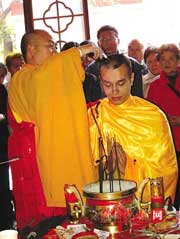
Lucas during his ordination at Xuanzang Temple in Nanjing last week. [China Daily]

He was ordained on November 10, becoming the first Italian, and perhaps the first foreign Buddhist monk in China, attracting crowds of reporters.

Lucas' ordination took place at Xuanzang Temple, well known for housing the relics of master monk Xuan Zang, who was famous for his 16-year pilgrimage to India and translating Buddhist scriptures in the early Tang Dynasty (618-907 AD).

Lucas used to visit the temple at weekends when he was studying Chinese at the nearby Southeast University.

Explaining his conversion from Catholicism to Buddhism, he said all religions share similar underlying basic truths though they have different cultural manifestations.

The master's graduate from the University of Rome speaks fluent Chinese after spending two years in China. He described his commitment to Buddhism as yuan fen, or destiny.

"Becoming a monk was rather an internal call determined by fate," said Lucas.

Despite the ease with which he changed his religious belief, his tutor at the temple was actually quite cautious in accepting the foreign disciple.

Master Chuan Zhen, the abbot, said he didn't accept Lucas until he passed one year of observation, to make sure that he did not make the choice on the spur of the moment.

"I found that although his knowledge of Buddhism was limited, his belief was strong," Chuan Zhen recalled, stressing that he has a very good understanding of classic Buddhist concepts.

For instance, Lucas' favorite Buddhist hymn is, "Put down the killing knife, and become a Buddhist at once".

"It means that human life is basically a struggle, but one can get internal peace once he stops struggling," said Lucas.

He was confident that he could obey the five basic precepts of morality defined in Buddhism, including commitments not to kill, drink alcohol or engage in sex.

Master Chuan Zhen has a major ambition - that Lucas can one day be like Matteo Ricci, the first foreigner to bring Catholicism to China in the late 16th century.

"I have high expectations of him," said Chuan Zhen. "Some day he might take Buddhism to Rome."